Blog / Qwen 4
Qwen 4 announced: what we know so far
Alibaba announced Qwen 4 at its Apsara conference in Hangzhou on 22 September. The company says the new generation is still in training.
Four models appeared on the conference slide: Qwen4-Max, Qwen4-Plus, Qwen4-Flash and Qwen4-27B. The slide said “coming soon”, without giving a release date.
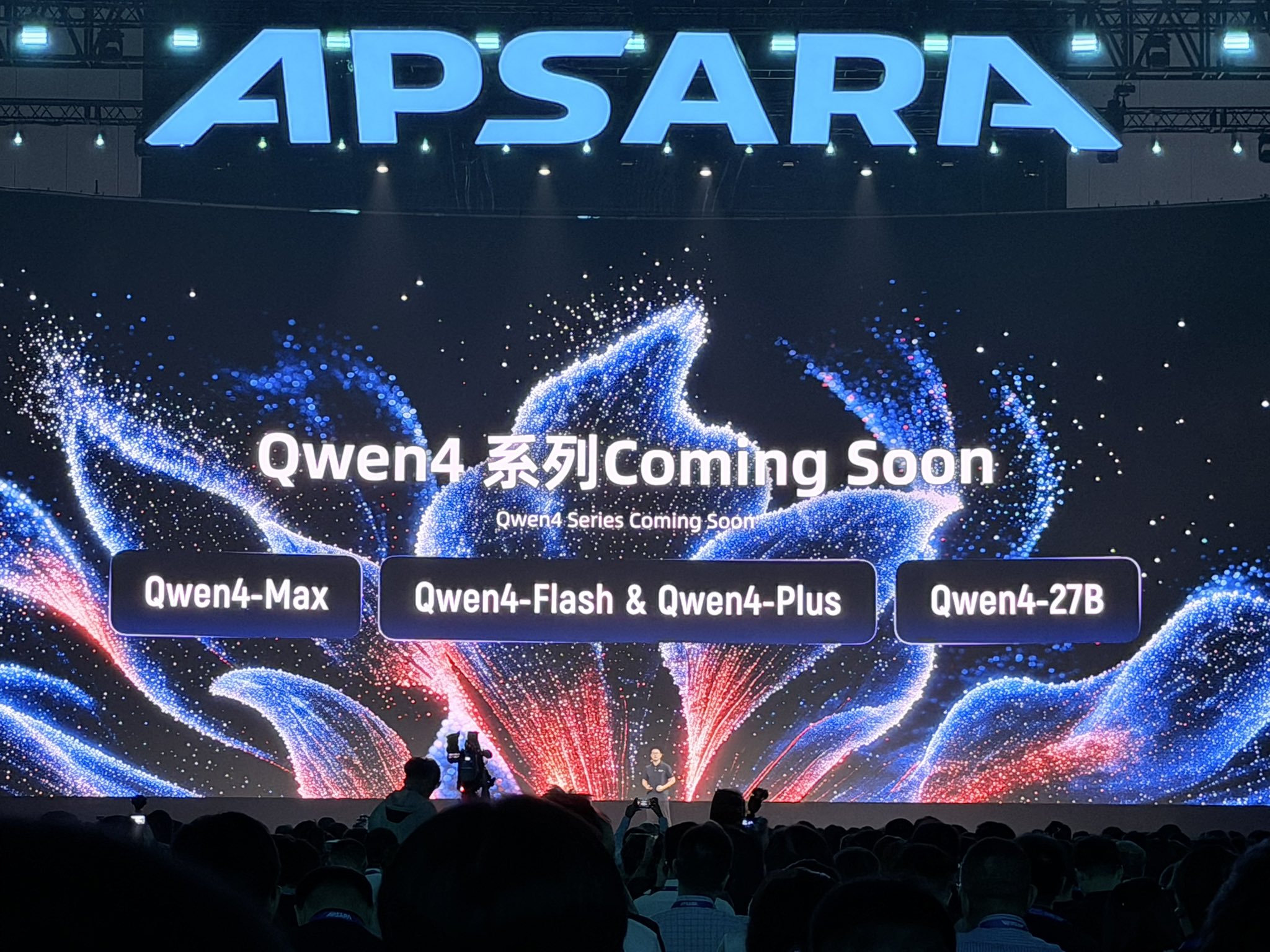
If you want to run Qwen4 on your own hardware, the 27B model is worth watching. The announcement didn't include weights, a licence or hardware requirements, though. We still don't know which versions will be available to download.
There is already an early look at the design. Qwen released Qwen3.8-Flash-Next in August as a preview of the architecture behind Qwen4. It accepts text, images and video, and can handle about 262,000 tokens of context, with an option to extend that to a million.
The preview's main network has 125 billion parameters, with about 6 billion active for each token. It also has a 51-billion-parameter lookup table for short token sequences, which can sit in normal RAM. Using fewer parameters per token saves computation, but the stored weights still need memory.
Qwen reports three efficiency gains for the Flash-Next architecture:
- Training: about one ninth of the cost of Qwen3.7-Plus.
- Processing prompts: 8.6 times the throughput of Qwen3.7-Plus when the prefix-cache hit rate is 90%. That test reuses most of the work from earlier inputs.
- Handling long inputs: at one million tokens, the Qwen Sparse Attention kernel is up to 7.6 times faster at processing input and 4.9 times faster during response generation in Qwen's tests. These figures measure the attention kernel, one part of the model's work.
The team also says the base preview beat Qwen3.7-Plus-Base on 8 of 14 benchmarks. The promise is similar or better answers with less computation.
Flash-Next is available under the Qwen Community License 1.0. The licences for the Qwen4 models haven't been announced. Our guess is that the 27B model will follow Qwen3.8-27B with an Apache 2.0 release, while some of the other versions will use Qwen's own terms.
At the same conference, Alibaba described an experiment in which Qwen3.8-Max helped improve its own training. The company says it completed 33 automated rounds over a month, raising its Artificial Analysis score from 40 to 45. That work was on Qwen3.8-Max; Qwen4 results are still to come.
Alibaba also outlined plans for models with 5 to 10 trillion parameters. That figure applies to the later Qwen 4.5 and Qwen 5 generations. It did not announce a parameter count for Qwen4-Max.
There are no Qwen4 prices or benchmarks in the announcement yet, so it's too early to say how it compares with what you can use today. Our guess is that the biggest gains will be in long prompts, coding and tasks that take several steps. If the preview's efficiency gains carry over, Plus and Flash could offer better performance for the same price, or similar performance for less.